Great Women In History

Chancellor Merkel.

Maggie Smith.

Dawn French.
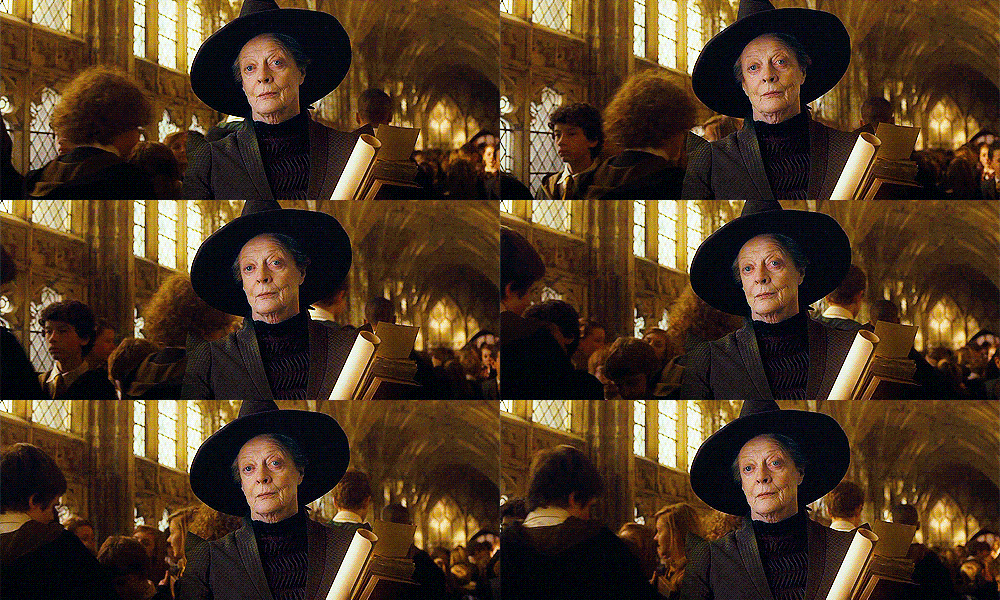
Harry Potter No GIF

Elections Merkel GIF by euronews
GIF by britbox
 
Jessica Cox was born in 1983 in Arizona, U.S.A. As would any other girl, Jessica got her driver’s license at the age of 16. After high school, she went on to graduate from the University of Arizona in 2005 with a bachelor's degree in psychology and a minor in communications.

Jessica flew in a single engine airplane for the first time in 2004. She earned her pilot's certificate on October 10, 2008, after three years of training, and is qualified to fly a light-sport aircraft to altitudes of 10,000 feet.

At the age of 10, Jessica began training in Taekwondo at a school in her hometown of Sierra Vista. At the age of 14, she earned her first black belt. has since gone on to earn her second- and third-degree black belts in the ATA. Jessica has also earned the title of 2014 Arizona State Champion in forms.

While some may think these things are no big achievements, I should mention that Jessica was born without arms. She drives a normal car and flies a plane without any special accommodations or equipment. She can even insert her contact lenses without assistance. She has never competed in special Olympics or tried to use her disability to her advantage, but has pursued helping others who are armless and those with other disabilities.
 
Jessica Cox was born in 1983 in Arizona, U.S.A. As would any other girl, Jessica got her driver’s license at the age of 16. After high school, she went on to graduate from the University of Arizona in 2005 with a bachelor's degree in psychology and a minor in communications.

Jessica flew in a single engine airplane for the first time in 2004. She earned her pilot's certificate on October 10, 2008, after three years of training, and is qualified to fly a light-sport aircraft to altitudes of 10,000 feet.

At the age of 10, Jessica began training in Taekwondo at a school in her hometown of Sierra Vista. At the age of 14, she earned her first black belt. has since gone on to earn her second- and third-degree black belts in the ATA. Jessica has also earned the title of 2014 Arizona State Champion in forms.

While some may think these things are no big achievements, I should mention that Jessica was born without arms. She drives a normal car and flies a plane without any special accommodations or equipment. She can even insert her contact lenses without assistance. She has never competed in special Olympics or tried to use her disability to her advantage, but has pursued helping others who are armless and those with other disabilities.
Thank You For Posting That ... It Is A Powerful Inspiration ...

One That Would Make Anyone Question Their Own Personal Complaints

About Whatever Adverse Situations They May Be Having In Their Own Lives
 
Lorraine Vivian Hansberry (May 19, 1930 – January 12, 1965) was a playwright and writer.[1] She was the first African American female author to have a play performed on Broadway. Her best-known work, the play A Raisin in the Sun, highlights the lives of black Americans in Chicago living under racial segregation. The title of the play was taken from the poem "Harlem" by Langston Hughes: "What happens to a dream deferred? Does it dry up like a raisin in the sun?" At the age of 29, she won the New York Drama Critics' Circle Award — making her the first African-American dramatist, the fifth woman, and the youngest playwright to do so.[2] Hansberry's family had struggled against segregation, challenging a restrictive covenant in the 1940 US Supreme Court case Hansberry v. Lee.

After she moved to New York City, Hansberry worked at the Pan-Africanist newspaper Freedom, where she worked with other intellectuals such as Paul Robeson and W. E. B. Du Bois. Much of her work during this time concerned the African struggles for liberation and their impact on the world. Hansberry's writings also discussed her lesbianism and the oppression of homosexuality.[3][4] She died of pancreatic cancer at the age of 34 during the Broadway run of her play The Sign in Sidney Brustein's Window in 1965.[5]Hansberry inspired the Nina Simone song "To Be Young, Gifted and Black", whose title-line came from Hansberry's autobiographical play.
 
Let's keep the thread civil and without profanity please. This thread is about empowering girls of all ages, showing them how others have overcome obstacles and persevered. Thank you to those that have such examples.

Grace Hopper (1906-1992)

A computer pioneer, Grace Hopper was rejected when she tried to join the U.S. Navy early in WWII - partly because her work as a mathematician and professor at Vassar College was too valuable to the war effort. She eventually was sworn into the U.S. Navy Reserve, and served in the WAVES (the women’s reserve).

She was assigned to the Bureau of Ships Computation Project at Harvard University, where as one of the first computer programmers ever, she was responsible for programming the Mark I (the IBM Automatic Sequence Controlled Calculator). She worked on top-secret projects vital to the war effort, such as computing rocket trajectories. In 1952, her team invented the “compiler,” the tool computer programmers use to turn their code into software. She was instrumental in the development of the computer language COBOL.

Among her many awards and achievements, she was awarded the National Medal of Technology by President George Bush in 1991, and posthumously received the Presidential Medal of Freedom in 2016 for her contributions to field of computer science.
 
Born Anna Mae Bullock, Tina Turner's performing career took off in the 1960s alongside Ike Turner. Her reign as a solo artist gained steam in 1984 when she released “Private Dancer.” The album would go on to win four Grammy Awards. Turner was known for her energetic performances, unique singing technique and her many chart-topping singles. In 1991, she and Ike Turner were inducted into the Rock and Roll Hall of Fame. The iconic ‘Queen of Rock and Roll’ Tina Turner has died at the age of 83.
Simply the best.
 
Olympe de Gouges born Marie Gouze; 7 May 1748 – 3 November 1793) was a French playwright and political activist. She is best known for her Declaration of the Rights of Woman and of the Female Citizen and other writings on women's rights and abolitionism.

Born in southwestern France, Gouges began her prolific career as a playwright in Paris in the 1780s. A passionate advocate of human rights, she was one of France's earliest public opponents of slavery. Her plays and pamphlets spanned a wide variety of issues including divorce and marriage, children's rights, unemployment, and social security. Gouges welcomed the outbreak of the French Revolution but soon became disenchanted when equal rights were not extended to women. In 1791, in response to the 1789 Declaration of the Rights of Man and of the Citizen, Gouges published her Declaration of the Rights of Woman and of the Female Citizen, in which she challenged the practice of male authority and advocated for equal rights for women.

Gouges was associated with the moderate Girondins and opposed the execution of Louis XVI. Her increasingly vehement writings, which attacked Robespierre's radical Montagnards and the Revolutionary government during the Reign of Terror, led to her eventual arrest and execution by guillotine in 1793.

Tomoe Gozen - Badass Woman in Japanese History

As one of the few female samurai legends, Tomoe has earned her place in martial arts history.
Tomoe did learn martial arts and had a unique opportunity to use her skills.

She is famed for going into battle alongside the samurai warrior Minamoto Yoshinaka, who she served with absolute loyalty; according to some sources she was also his mistress or even his wife. They fought together in the Gempei War (1180 – 1185), which she is believed to have survived, unlike her master Yoshinaka. In one battle, she is reported to have single-handedly defended a bridge against dozens of attackers.

In another, she is said to have killed many samurai warriors one after another in single combat and then killed their leader, Uchida Iyeyoshi. Attempting to drag her from her horse, Uchida infuriated Tomoe who promptly decapitated him and delivered his head as a trophy to Yoshinaka. Her most famous story is from the Battle of Awazu (1184) where Yoshinaka was finally defeated by his enemies. When the battle was lost, Yoshinaka told Tomoe he will fight to the death but she should leave the battlefield as he would be ashamed to die fighting with a woman; after killing another opposing samurai warrior, she complied and escaped.

Tomoe Gozen is unique as she is the only female warrior who is described in detail in the ancient Japanese samurai war tales. The Heike Monogatari does not mention her again after she leaves the Battle of Awazu but according to another source, the Gempei Seisuki, she had been ordered by Yoshinaka to go to his home province and tell the story of his final battle in a bid to make his exploits a become a part of samurai legend.
 
Mary Wollstonecraft (1759-1797), an English writer and philosopher, was a prominent early advocate of women’s rights. She is often considered to be one of the founding feminist philosophers.

In 1792, she published what is arguably her best known work, A Vindication of the Rights of Woman. Wollstonecraft decried a lack of educational opportunities for women, and asserted that both men and women should be treated as equal, rational beings. She promoted a changing social order where a greater emphasis would be placed on reason.

In 1963, theoretical physicist Maria Goeppert Mayer became the second woman to win a Nobel Prize in physics, 60 years after Marie Curie won the award.

Goeppert Mayer was born on June 28, 1906, in Kattowitz, Germany (now Katowice, Poland). Although women from her generation rarely attended university, Goeppert Mayer went to the University at Göttingen in Germany, where she plunged into the relatively new and exciting field of quantum mechanics.

By 1930, at age 24, she had earned her doctorate in theoretical physics. She married the American Joseph Edward Mayer and moved with him so he could work at Johns Hopkins University in Baltimore. The university wouldn't employ her, given that it was the Depression, but she continued working on physics anyway.

When the couple moved to Columbia University in New York, she worked on the separation of uranium isotopes for the atomic bomb project, according to Britannica. Her later research at the University of Chicago on the architecture of nuclei — how different orbital levels held different components of the nucleus in atoms — won her a Nobel Prize that she shared with two other scientists.
 
"There is a terrible hunger for love. We all experience that in our lives-the pain the loneliness. We must have the courage to recognize it. The poor may have rights in their own family. Find them. Love them."

Mother Teresa
was born Agnes Gonxha Bojaxhiu in Uskup, Ottoman Empire (now Skopje, North Macedonia), on August 26, 1910. Her family was of Albanian descent. At the age of twelve, she felt strongly the call of God. She knew she had to be a missionary to spread the love of Christ. At the age of eighteen, she left her parental home in Skopje and joined the Sisters of Loreto, an Irish community of nuns with missions in India. After a few months of training in Dublin she was sent to India, where on May 24, 1931, she took her initial vows as a nun. From 1931 to 1948 Mother Teresa taught at St. Mary’s High School in Calcutta, but the suffering and poverty she glimpsed outside the convent walls made such a deep impression on her that in 1948 she received permission from her superiors to leave the convent school and devote herself to working among the poorest of the poor in the slums of Calcutta. Although she had no funds, she depended on Divine Providence and started an open-air school for slum children. Soon she was joined by voluntary helpers, and financial support was also forthcoming. This made it possible for her to extend the scope of her work.

On October 7, 1950, Mother Teresa received permission from the Holy See to start her own order, “The Missionaries of Charity”, whose primary task was to love and care for those persons nobody was prepared to look after. In 1965 the Society became an International Religious Family by a decree of Pope Paul VI.

Today the order comprises Active and Contemplative branches of Sisters and Brothers in many countries. In 1963 both the Contemplative branch of the Sisters and the Active branch of the Brothers was founded. In 1979 the Contemplative branch of the Brothers was added, and in 1984 the Priest branch was established.

The Society of Missionaries has spread all over the world, including the former Soviet Union and Eastern European countries. They provide effective help to the poorest of the poor in a number of countries in Asia, Africa, and Latin America, and they undertake relief work in the wake of natural catastrophes such as floods, epidemics, and famine, and for refugees. The order also has houses in North America, Europe, and Australia, where they take care of the shut-ins, alcoholics, homeless, and AIDS sufferers.

The Missionaries of Charity throughout the world are aided and assisted by Co-Workers who became an official International Association on March 29, 1969. By the 1990s there were over one million Co-Workers in more than 40 countries. Along with their Co-Workers, the lay Missionaries of Charity try to follow Mother Teresa’s spirit and charism in their families.

Mother Teresa’s work has been recognized and acclaimed throughout the world and she has received a number of awards and distinctions, including the Pope John XXIII Peace Prize (1971) and the Nehru Prize for her promotion of international peace and understanding (1972). She also received the Balzan Prize (1979) and the Templeton and Magsaysay awards.

From Nobel Lectures, Peace 1971-1980, Editor-in-Charge Tore Frängsmyr, Editor Irwin Abrams, World Scientific Publishing Co., Singapore, 1997
This autobiography/biography was written at the time of the award and first published in the book series Les Prix Nobel. It was later edited and republished in Nobel Lectures. To cite this document, always state the source as shown above.

"Everybody today seems to be in such a terrible rush, anxious for greater developments and greater riches and so on so that children have very little time for their parents. Parents have very little time for each other and in the home begins the disruption of peace in the world."
 
Elizabeth Blackwell: Born February 3, 1821 – Died May 32, 1910. She was a British and American physician, notable as the first woman to receive a medical degree in the United States, and the first woman on the Medical Register of the General Medical Council for the United Kingdom. Blackwell played an important role in both the United States and the United Kingdom as a social reformer, and was a pioneer in promoting education for women in medicine. Her contributions remain celebrated with the Elizabeth Blackwell Medal, awarded annually to a woman who has made a significant contribution to the promotion of women in medicine.

Blackwell, was not initially interested in a career in medicine. She became a schoolteacher in order to support her family. This occupation was seen as suitable for women during the 1800s; however, she soon found it unsuitable for her. Blackwell's interest in medicine was sparked after a friend fell ill and remarked that, had a female doctor cared for her, she might not have suffered so much. Blackwell began applying to medical schools and immediately began to endure the prejudice against her sex that would persist throughout her career. She was rejected from each medical school she applied to, except Geneva Medical College in New York, in which the male students voted for Blackwell's acceptance. Thus, in 1847, Blackwell became the first woman to attend medical school in the United States.

Blackwell's inaugural thesis on typhoid fever, published in 1849 in the Buffalo Medical Journal and Monthly Review, shortly after she graduated, was the first medical article published by a female student from the United States. It portrayed a strong sense of empathy and sensitivity to human suffering, as well as strong advocacy for economic and social justice. This perspective was deemed by the medical community as feminine.

Blackwell founded the New York Infirmary for Women and Children with her sister Emily Blackwell in 1857, and began giving lectures to female audiences on the importance of educating girls. She played a significant role during the American Civil War by organizing nurses, and the Infirmary developed a medical school program for women, providing substantial work with patients (clinical education). Returning to England, she helped found the London School of Medicine for Women in 1874.
 
well, I could say rosa parks stood up for her rights. she refused to give up her seat on a bus to a white person and got arrested. probably sparked a boycott and helped the Civil Rights Movement. I think she received many honors for her courage and activism? I studied this awhile ago, can't remember all of it.
 
It was illegal for women to act on the English stage until the year 1660. Yes that's right. The church forbade the appearance of women on the stage, although on the continent things were very different. It was only when King Charles II – a theatre-lover no less – granted a charter to Drury Lane and made it a requirement that all female parts should be played by women. The first female actress on the English stage was Margaret Hughes (1630 - 1719), playing Desdemona in Othello in 1660. While she may or may not have been the first actress on the English stage no one really knows for sure, but she is credited with that achievement.

 
It was illegal for women to act on the English stage until the year 1660. Yes that's right. The church forbade the appearance of women on the stage, although on the continent things were very different. It was only when King Charles II – a theatre-lover no less – granted a charter to Drury Lane and made it a requirement that all female parts should be played by women. The first female actress on the English stage was Margaret Hughes (1630 - 1719), playing Desdemona in Othello in 1660. While she may or may not have been the first actress on the English stage no one really knows for sure, but she is credited with that achievement.

Yay for Restoration Theatre!
 
Kathrine Switzer competed in the 1967 Boston Marathon even though she wasn’t allowed to. Why was she not allowed? Because she was a woman.

In 1967, Switzer registered for the Boston Marathon as ‘K. V. Switzer’. Because she was dressed in oversized sweat clothes, she was able to go undetected long enough to get started. But after the race began, the race director realized Switzer was a woman and attempted to forcibly remove her, along with another man, but she was able to out maneuver them, and she continued on and completed the course, becoming the first woman to run in the Boston Marathon. Photos of this “Boston Incident” ignited the women’s running revolution at a time when popular theory held that women were not strong enough to run the 26.2 mile distance.

Thanks to the efforts of Switzer and others, women were officially allowed into road races in 1971. The next year, she earned her M.A. in public communications from Syracuse University.

In 1977, Switzer founded the Avon International Running Circuit, an initiative that created running programs in 27 countries for over 1 million women. These efforts eventually led to the inclusion of the women’s marathon as an official event in the Olympic Games. In 1984, 49 athletes from 28 countries ran the inaugural Women’s Olympic Marathon.

Switzer went on to simultaneous careers as a fitness expert, television broadcaster, author, and public speaker. She formed her own company, AtAlanta Sports Promotions and is an Emmy Award-winning television commentator who has done broadcast work for ABC, CBS, NBC, and ESPN. Switzer’s books include Marathon Woman and Running and Walking for Women Over 40.

Switzer has revolutionized the sport of running for women, while at the same time increasing awareness of healthy lifestyles and the importance of fitness. She once noted that, “Triumph over adversity, that’s what the marathon is all about. Nothing in life can’t triumph after that.”

A member of the inaugural class of the National Distance Running Hall of Fame (1998), Switzer was named one of four “Visionaries of the Century” by Runner’s World Magazine (2002), and has received the Abebe Bikila Award from the New York Road Runners Club for her global contribution to running (2003).

Still recognized as a leader in the running world, Switzer has completed over thirty-seven marathons and dedicated her career to creating opportunities and equal sport status for women.
 
Top