
You are using an out of date browser. It may not display this or other websites correctly.
You should upgrade or use an alternative browser.
You should upgrade or use an alternative browser.
Wins Last Post
- Thread starter emileh
- Start date
- Status
- Not open for further replies.
D
Deleted member 306961
Guest
Oi steal my post

D
Deleted member 306961
Guest



Gimme yours

D
Deleted member 306961
Guest


.Princessa
LetYourSmileChangeTheWorldNotTheWorldChangeYourSmi

.Princessa
LetYourSmileChangeTheWorldNotTheWorldChangeYourSmi


D
Deleted member 306961
Guest
Whys it pointing at me
D
Deleted member 306961
Guest



D
Deleted member 306961
Guest





IamDave
Gold Member
As if I would.
Welcome to Club 113
Where membership's a smiling face
Brush shoulders with the stars
Where strangers take you by the hand
And welcome you to wonderland
From beneath their panamas
Welcome to Club 113
Where membership's a smiling face
Brush shoulders with the stars
Where strangers take you by the hand
And welcome you to wonderland
From beneath their panamas

Right back atcha 😛I tomato faced you 😝
.Princessa
LetYourSmileChangeTheWorldNotTheWorldChangeYourSmi
1,028
.Princessa
LetYourSmileChangeTheWorldNotTheWorldChangeYourSmi
1,029
.Princessa
LetYourSmileChangeTheWorldNotTheWorldChangeYourSmi
.Princessa
LetYourSmileChangeTheWorldNotTheWorldChangeYourSmi

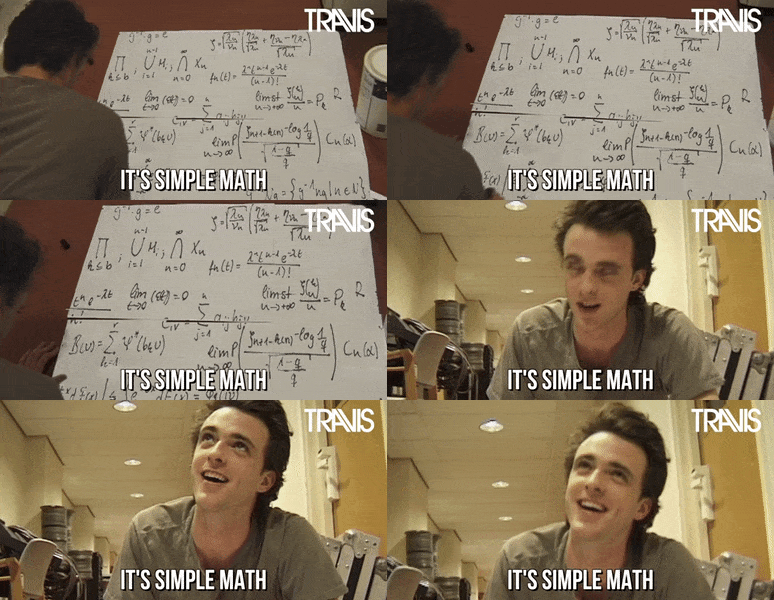
The winning number is going to be something like the square root of 1,234 to the power of 78 multiplied by 27 divided by 948 minus the nearest prime number, plus 3.14 rounded up to the nearest whole number
First you have to know the base I'm using and then you have to factor in √-1 to reach a solution.The winning number is going to be something like the square root of 1,234 to the power of 78 multiplied by 27 divided by 948 minus the nearest prime number, plus 3.14 rounded up to the nearest whole number
IamDave
Gold Member
You sound like my old maths teacherFirst you have to know the base I'm using and then you have to factor in √-1 to reach a solution.
Am I along the right lines in this thinking:First you have to know the base I'm using and then you have to factor in √-1 to reach a solution.
This statement is referring to a problem that involves complex numbers and possibly non-standard numerical bases. Here’s a breakdown of what it means:
1. “First you have to know the base I’m using”:
This implies that the numbers involved may be expressed in a base other than the familiar base-10 (decimal). In mathematics and computer science, bases such as binary (base-2), octal (base-8), or hexadecimal (base-16) are commonly used. Knowing the base is essential for interpreting and manipulating the numbers correctly.
2. “Factor in √-1”:
The square root of -1, denoted as , is a fundamental concept in complex numbers. In mathematics, is defined as the imaginary unit, where . Factoring in means you’re working in the realm of complex numbers, and the solution will involve imaginary or complex components.
To summarise, we are dealing with a problem that involves both a specific numerical base (other than base-10) and complex numbers (which include the imaginary unit ). To solve the problem, you’d need to first convert or interpret the numbers based on the given base and then incorporate complex number operations.
.Princessa
LetYourSmileChangeTheWorldNotTheWorldChangeYourSmi


.Princessa
LetYourSmileChangeTheWorldNotTheWorldChangeYourSmi



.Princessa
LetYourSmileChangeTheWorldNotTheWorldChangeYourSmi
It's 4:14 pm
Sunday funday October 6, 2024.
1,044 lost.
I been fasting ALL morning and day. Fasting is good for me.
Now I'm hungry. I'll have a sandwich now.
Sunday funday October 6, 2024.
1,044 lost.
I been fasting ALL morning and day. Fasting is good for me.
Now I'm hungry. I'll have a sandwich now.
Am I along the right lines in this thinking:
This statement is referring to a problem that involves complex numbers and possibly non-standard numerical bases. Here’s a breakdown of what it means:
1. “First you have to know the base I’m using”:
This implies that the numbers involved may be expressed in a base other than the familiar base-10 (decimal). In mathematics and computer science, bases such as binary (base-2), octal (base-8), or hexadecimal (base-16) are commonly used. Knowing the base is essential for interpreting and manipulating the numbers correctly.
Yep. This is a bit of a red herring. Maths works the same in any base
2. “Factor in √-1”:
The square root of -1, denoted as , is a fundamental concept in complex numbers. In mathematics, is defined as the imaginary unit, where . Factoring in means you’re working in the realm of complex numbers, and the solution will involve imaginary or complex components.
To summarise, we are dealing with a problem that involves both a specific numerical base (other than base-10) and complex numbers (which include the imaginary unit ). To solve the problem, you’d need to first convert or interpret the numbers based on the given base and then incorporate complex number operations.
There are problems in maths that simply can't be solved without invoking imaginary numbers (AC calculations are an example as are quadratics). How they work is interesting because they're introduced, the problem is calculated and then they're cancelled out to leave a real solution so you're partly right.
Of course, wait and see is so much easier 😛
.Princessa
LetYourSmileChangeTheWorldNotTheWorldChangeYourSmi
My sandwich was so good.
.Princessa
LetYourSmileChangeTheWorldNotTheWorldChangeYourSmi
The Pittsburgh Steelers and The Dallas Cowboys Game is delay because of rain and lightning. ⚡ 🌩️
D
Deleted member 304663
Guest
SIR PRINCESSA WITH A CAPITAL PHowdy,
Excuse you. Excuse me. I am all female 100%. I'm not a sir. I'm not trying to cause any problems with you. I'm just letting you know that I'm a female. So I would be a ma'am. I hope you're doing well and I hope I'm winning this game. I hope you win too. Have a good evening. It is 5:55 p.m. September 23rd 2024 Monday. I wish you nothing but the best. Bye for now I got to go to church tonight. And I hope the Washington Commanders win tonight. I predict the Washington Commanders to win and I predict the Buffalo Bills to win tonight. Be well and be safe. God bless you and your family. God bless your friends. God bless your neighbors. God bless his whole wide world. God bless everybody.

Post 1,049
Interesting fact: 1,049 is the 176th prime number
Interesting fact: 1,049 is the 176th prime number
But when I put this:
I guess I'll just have to wait and see
into CHAT GPT, it draws a blank 🙁Of course, wait and see is so much easier 😛
I guess I'll just have to wait and see

Sir, you are ranting againHowdy,
Excuse you. Excuse me. I am all female 100%. I'm not a sir. I'm not trying to cause any problems with you. I'm just letting you know that I'm a female. So I would be a ma'am. I hope you're doing well and I hope I'm winning this game. I hope you win too. Have a good evening. It is 5:55 p.m. September 23rd 2024 Monday. I wish you nothing but the best. Bye for now I got to go to church tonight. And I hope the Washington Commanders win tonight. I predict the Washington Commanders to win and I predict the Buffalo Bills to win tonight. Be well and be safe. God bless you and your family. God bless your friends. God bless your neighbors. God bless his whole wide world. God bless everybody.
.Princessa
LetYourSmileChangeTheWorldNotTheWorldChangeYourSmi



Chat GPT just isn't smart enough to decode it 😛But when I put this:
into CHAT GPT, it draws a blank 🙁
I guess I'll just have to wait and see

GothandRock
Gold Member
Will it be one thousand something or higher?

GothandRock
Gold Member
I don't have patience for infinity
.Princessa
LetYourSmileChangeTheWorldNotTheWorldChangeYourSmi

She posts at a count of 1056 😛Will it be one thousand something or higher?
How about ∞-1?I don't have patience for infinity
D
Deleted member 303835
Guest
I’m last and I claim my prize.
No but I am
That's no way to talk about your admin @Inkandtatts10-66
Suspicious person
@Inkandtatts don't laugh at her post out of pity. Make her say something funny first.

Define questionable.
Define content.
Define content.

DING DING DING
We have a winner folks! @Inkandtatts you hit the magic number 1074. You're up to start the next one (for which you'll be relieved because no more mangled thread titles 😛 ).
@Apollo could you add @Inkandtatts to the winner list and close this please?
We have a winner folks! @Inkandtatts you hit the magic number 1074. You're up to start the next one (for which you'll be relieved because no more mangled thread titles 😛 ).
@Apollo could you add @Inkandtatts to the winner list and close this please?

Sore loser (as always 😛 )Rigged
D
Deleted member 306961
Guest
Congratulations @Inkandtatts 💋
I will not stand for your parlour tricks. You're just a troll.Sore loser (as always 😛 )
That's always the case unless you have your zimmer at hand.I will not stand for your parlour tricks. You're just a troll.
Questionable content. Cyber bullying. Tomato face worthy.That's always the case unless you have your zimmer at hand.
It's yer age.Questionable content. Cyber bullying. Tomato face worthy.
How many times do I need to say ask nicely for her to please stop red-facing me at emileh?Help help I'm being wrinkly tomato face attacked!
I even tag the um's before. I told you all for emileh to stop tagging me. I now have 1,149 red faces. This is harassment. I have done my part to STOP the red faces. emileh needs to stop please.

New one is up !
 forum.chat-avenue.com

Last Post Wins Tomato Edition 🥷🍅🥷
Tomatoes are so good for you. Get your daily dose I’m so sorry @Øli you were so close.
forum.chat-avenue.com
- Status
- Not open for further replies.